- Up or down?
- What is Dow Theory?
- How is a candlestick chart constructed?
- When should I buy and sell?
Technical Analysis can answer these questions.
To learn more about technical analysis, sign up for one of the courses that I teach at
BPP Hyperion in London. You will learn the basics of technical analysis, and at the end
of the course apply your new skills in making forecasts for leading shares. These forecasts
have in the past been very good, as the track record shows.
I have written a trading simulator program which is available to course participants.
Click here to download it (password needed).
Contact me for further info.
Track record
At each course, starting Nov 2000, participants given 5-year weekly charts of the UK FTSE 100 companies
and were asked to make forecasts of which stocks would be most likely to either rise or fall.
The predictions were used to construct
a portfolio of longs (where shares were predicted to rise) and shorts (for expected falls).
The portfolios were tracked for 20 weeks after the forecast was made.
Forecast 2: Mar 2001, Stocks long 6, Stocks short 5
Forecast 3: May 2001, Stocks long 2, Stocks short 6
Forecast 4: Sep 2001, Stocks long 8, Stocks short 6
Example: March 01 portfolio valued as at 27 Jun 01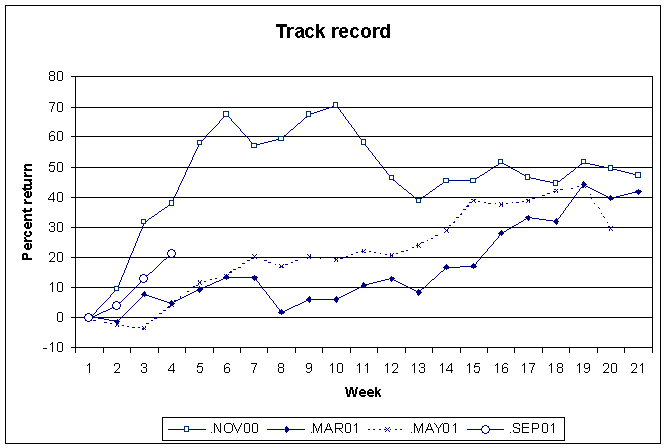
Forecast 1: Nov 2000, Stocks long 1, Stocks short 2
Highest profit: 71%, worst loss: 0%
Highest profit: 44%, worst loss: -1%
(after 19 weeks)
Highest profit: 44%, worst loss: -3%
(after 3 weeks)
Highest profit: 21%, worst loss: 0%
Initially, the total value of all the long positions is £100,000, and the total market value of the
short
positions is also £100,000. The £100,000 of longs is split equally between each long holding, so for
example if the portfolio contains 5 longs, each long starts with a value of £20,000.
If the share price is £4, the number of shares held in that company (which is fixed for the life of the portfolio) is therefore 5,000.
The same procedure is used for the short positions.
Longs No of
sharesMarch 01
priceCost
June 01
priceJune 01
mkt valueAllied Domecq 3,903 427 £16,667 3,903 £17,544 Anglo American 1,479 1127 £16,667 1,479 £15,521 Imperial Tobacco 2,268 735 £16,667 2,268 £18,685 Reckitt Benckiser 1,754 950 £16,667 1,754 £18,158 Reed Intl 2,402 694 £16,667 2,402 £14,673 Tesco 6,361 262 £16,667 6,361 £16,952 Total £100,000 £101,533 Profit £1,533
Shorts No of
sharesMarch 01
priceCost
June 01
priceJune 01
mkt valueMarconi 4,292 466 £20,000 237 £10,172 Pearson 1,320 1515 £20,000 1125 £14,851 Sage 6,873 291 £20,000 262 £18,024 Schroder 1,695 1180 £20,000 831 £14,076 Spirent 5,277 379 £20,000 177 £9,340 20 20 Total £100,000 £66,464 Profit £33,536
Total profit: £35,070 or 35.07%